Beyond the Event: What Sports Audiences Are Signaling for 2027
Most brands planned 2026 sports as a calendar of major events: the Winter Olympics, Champions League final, FIFA World Cup, Wimbledon and Tour de France.
As brands begin looking toward 2027, from the FIFA Women’s World Cup and Rugby World Cup to another year of Grand Slams, Formula 1, cycling and major club competitions, there is an opportunity to plan differently.
Dailymotion’s 2026 audience data shows why.
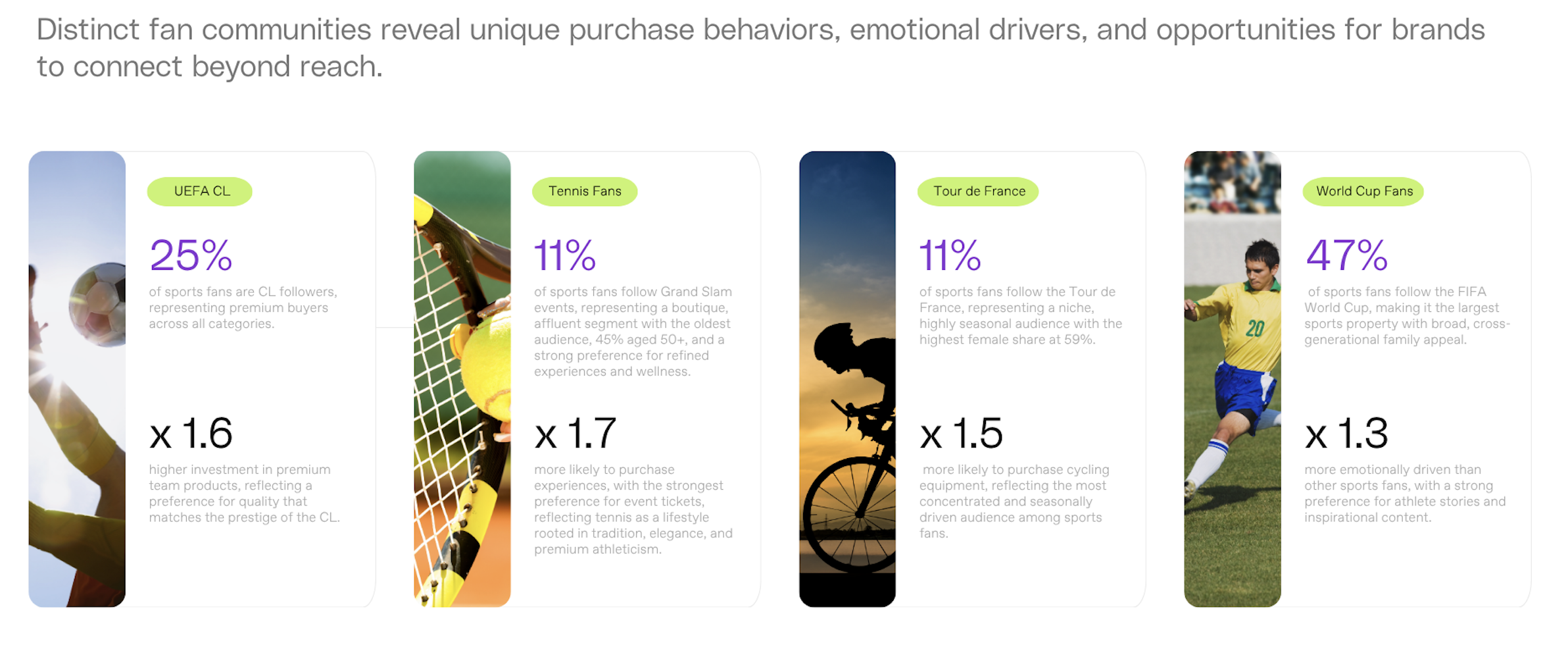
World Cup followers represented 47% of the sports audience measured, while Champions League followers represented 25%. But scale tells only part of the story. The behaviors surrounding those audiences were markedly different.
Champions League followers were 1.6 times more likely to invest in premium products, reflecting an audience associated with the prestige of the competition. World Cup followers were 1.3 times more emotionally driven than other sports fans, with strong preferences for athlete stories and inspirational content.
Smaller sports communities revealed different commercial signals again.
Grand Slam followers represented 11% of sports fans measured and skewed older and female, with 45% aged 50 or above. They were 1.7 times more likely to purchase experiences, with strong preferences for event tickets, travel and wellness. Tour de France followers also represented 11% of sports fans, were 59% female and were 1.5 times more likely to purchase cycling equipment.
The differences matter because all four groups could easily sit within the same broad “sports fan” audience, despite demonstrating very different interests and purchase behaviors.
The broad sports fan is not an audience
Treating sports fandom as one audience category can obscure more than it reveals.
People move between sports, competitions, athletes, content and screens. The behaviors they demonstrate around those interests are not necessarily the same.
There is significant crossover between sports, too. Among the cycling audience measured in Dailymotion’s study, 96% also followed FIFA content and 92% followed Copa Libertadores. Among tennis followers, 13% also followed the Tour de France.
Even within a single competition, attention can become concentrated around particular personalities and stories. During the World Cup, for example, Dailymotion viewing data showed that a relatively small group of players accounted for the majority of player-related viewing, while high completion rates showed audiences actively staying with that content.
The same variation appears across screens and throughout the day.
Dailymotion’s 2026 research found mobile dominating pre-match content and social engagement around major football moments, while CTV was strongest for live matches and full replays. Desktop played a greater role around news and analysis.
Tour de France audiences produced a different pattern. Attention peaked between 1 p.m. and 5 p.m., followed by another peak between 6 p.m. and 9 p.m. around highlights and review content.
For buyers, this turns the sports calendar into more than a schedule of events. Viewing behavior can show when attention is building, where audiences are watching, which content is driving engagement and which interests are emerging around the event, giving brands more precise signals for when, where and how to reach them.
The signal does not come from one place
Sports audiences move across TV screens, publishers, creators, and social platforms.
A fan might encounter an athlete through creator content or a social clip, read analysis from a sports publisher, watch highlights on a publisher site and later move to longer-form video or a full replay on CTV.
Across Dailymotion’s ecosystem, audiences engage with sports content from major publishers and broadcasters including L’Équipe, La Marca, Gazza Dello Sport, and CANAL+, as well as content around properties such as the Tour de France, major CTV networks, and creator content.
Those environments reveal different parts of the audience journey. Publisher consumption can show which teams, athletes, competitions and stories people are actively seeking out. Broadcaster content can provide signals around sustained engagement with premium sports programming. Creator and social-native signals can help identify the personalities, conversations and cultural moments gaining traction around an event.
That last layer is particularly important in sport, where audience behavior can change quickly. A breakout performance, an athlete or a cultural moment can suddenly shift what people are watching and engaging with. A static “football fan” or “tennis fan” segment may still describe that person, but it does not necessarily capture what is driving their attention at that moment.
This is where signals become useful. Rather than relying on a single audience label, Ray brings together video consumption, contextual, behavioral, device, timing, intent and social-native signals to identify the patterns forming around an audience as they emerge.
For advertisers, that means understanding not only who the audience is, but what they are signaling now. Ray can use those patterns to identify the audiences most relevant to a brand, understand when their interest is intensifying and find them across relevant video environments when those signals are strongest.
That changes the role of the sports calendar. Instead of simply telling a brand when an event will happen, it provides a framework for anticipating moments of attention, while audience signals help determine which consumers within those moments matter to the brand.
Build Smarter Sports Media Strategies with Audience Intelligence:
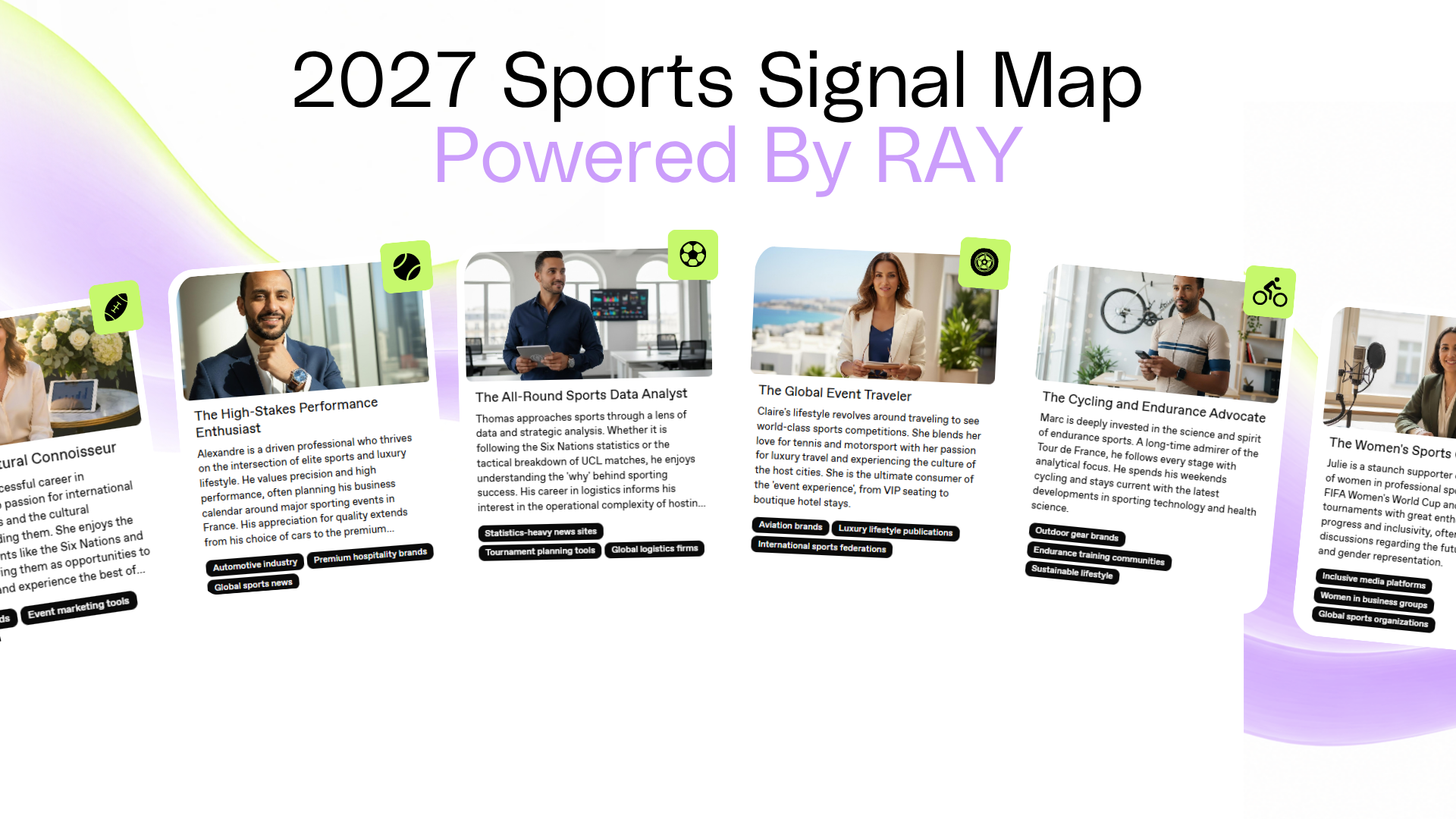
We used Ray to build a France 2027 Sports Signal Map across major moments including the Six Nations, Roland-Garros, Champions League, FIFA Women’s World Cup, Wimbledon, Tour de France, Formula 1 and Rugby World Cup.
Rather than treating the calendar as a list of sponsorship or media opportunities, we analyzed the audiences forming around each event and compared them with a broad sports-fan baseline. The analysis looked at audience profile, video interests, adjacent passions, purchase signals, cross-sport overlap, screens, dayparts and how behavior changes around different sporting moments.
Across more than 10,000 media-owner and partner properties, Dailymotion’s ecosystem reaches more than 400 million people each month, giving Ray signals from across the video journey to identify patterns that a broad sports segment alone may miss.
The 2026 findings demonstrate the value of that approach. Grand Slam and Tour de France followers each represented 11% of the sports audience measured, yet showed different audience profiles and commercial behaviors. World Cup and Champions League audiences were larger, but again demonstrated different signals.
For brands, that creates a more precise way to approach the calendar. Rather than assuming everyone following a major football tournament represents the same opportunity, a brand can look for the interests and behaviors most relevant to its objectives within that audience. A smaller sports audience with stronger signals around a relevant category may ultimately be more valuable than a much larger general sports segment.
The result is a sports plan built around audience behavior rather than event labels. Brands can identify which signals matter to them, when those signals intensify and which content, screens and contexts provide the strongest opportunity to connect.
The value of the sports calendar is not simply knowing what audiences will watch next. It is recognizing the patterns forming around those moments early enough to act on them.
Ready to find your perfect audience, contact us to learn more.
In this article