
Advertisers have more audience signals than they know what to do with. Dailymotion Business believes the next opportunity for AI lies in understanding what those signals actually mean.
Every video interaction reveals something about consumer behavior. What audiences choose to watch, how long they stay engaged, which creators they follow and the content they return to all provide clues about their interests and motivations.
Yet much of that information remains fragmented across publishers, social platforms, creator communities and connected TV. Each environment captures a different part of the audience journey, leaving advertisers with an abundance of signals but an incomplete understanding of what they mean.
For brands and advertisers, the challenge is increasingly one of interpretation. How can these signals reveal emerging interests, identify relevant audiences and inform decisions about creative, media and campaign strategy?
Dailymotion Business is addressing that question with Ray, its AI-powered Agentic Operating System, designed to connect video signals and translate them into actionable advertising intelligence.
Drawing on creation, social, consumption and campaign signals, Ray identifies patterns in audience behavior that can inform how advertisers plan, develop, activate and measure campaigns.
The premise is straightforward: the real value of video data lies in understanding the relationships between individual interactions and using those insights to make more informed advertising decisions.
From audience segments to behavioral intelligence
One of the more interesting aspects of Ray is how it approaches audience development.
Most advertising platforms can identify consumers based on demographic characteristics, declared interests or previous interactions. Ray’s methodology starts with patterns in video behavior.
Its three-stage process, Identify, Decode and Mirror, analyzes behavioral signals across more than 400 million audience profiles.

Identify matches an advertiser’s brief against relevant viewing behaviors. Decode examines the common characteristics within those audiences, organizing them into personas that reflect content interests, consumption habits and engagement patterns.
Mirror then looks for additional consumers exhibiting similar behavioral characteristics.
With Dailymotion Business’s Ray, advertisers can expand a seed audience by up to five times while maintaining 95% persona precision. The three-stage Identify, Decode and Mirror process delivers actionable audience intelligence in approximately 60 seconds.
The distinction matters because the resulting audience profiles can inform decisions beyond media targeting.
Ray can help identify which content topics are relevant to different audiences, when those consumers are most engaged, which screens they use and how creative messaging might be adapted.
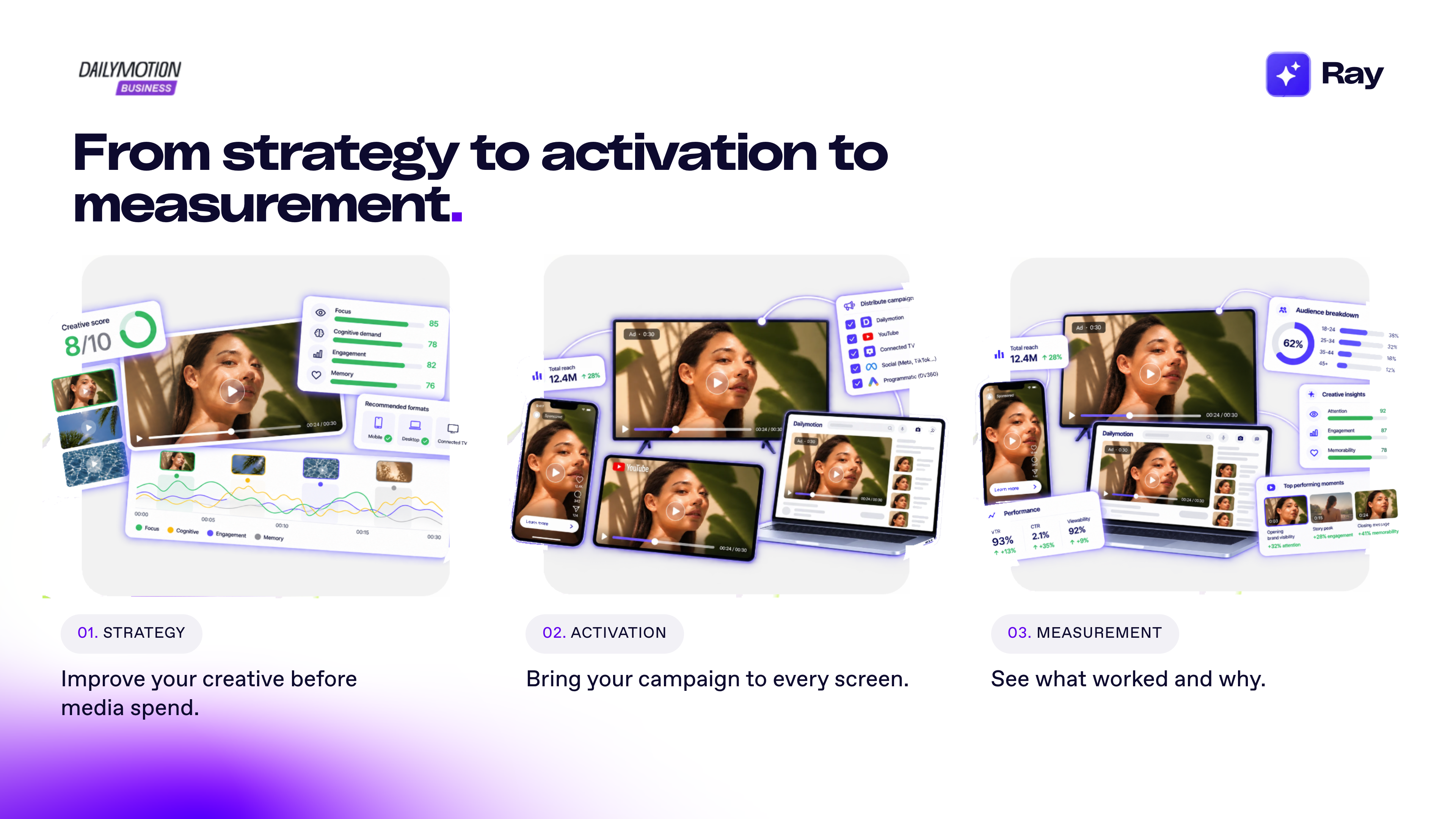
Its capabilities also extend into creative pre-testing, analyzing attention, engagement, memory and cognitive demand before campaigns launch.
For an advertiser, this introduces a more connected planning process. The same audience intelligence used to identify potential customers can also inform the content environments selected for a campaign and the creative recommendations developed around it.
The opportunity is to make audience intelligence useful throughout campaign planning, rather than treating it as an input that disappears once media buying begins.
Why the context behind video engagement matters
The signals Ray analyzes come from four different areas of the video ecosystem.
Creation signals provide information about content topics, formats, visual styles and metadata. Social signals capture how communities interact with content through shares, saves, comments and follows. Consumption signals reveal viewing behaviors such as watch time, completion rates, replays, devices and time of day. Campaign signals provide information about advertising exposure, attention, engagement and conversions.
The value comes from examining the relationships between these signals.
Someone watching a video about electric vehicles may be casually interested in automotive technology. But repeated engagement with hybrid vehicle reviews, creator discussions and related content could suggest a more sustained interest.
For advertisers, understanding those patterns can help identify audiences whose behaviors align with campaign objectives.
Dailymotion Business says Ray draws on behavioral intelligence from more than 400 million video consumers, supported by an ecosystem generating over 5 billion video views per month.
That breadth of information allows Ray to examine audience behavior across different viewing contexts and identify patterns that may not be visible through individual datasets.
It also introduces another consideration for advertisers: the relevance of the environment in which an audience encounters a message.
An audience may engage with particular topics on mobile during the day but consume different types of content on connected TV in the evening. Those differences can influence when and where advertising is activated.
Ray’s temporal intelligence and device strategy capabilities help campaign teams explore those patterns, alongside relevant content topics and recommendations for online video and connected TV environments.
Bringing audience intelligence into creative development
The application of audience intelligence to creative strategy is another area where Ray is extending its role.
Creative development and media planning have traditionally operated through different workflows. Audience research may influence an initial campaign brief, but the insights used to define a target audience do not always carry through to creative evaluation.
Ray is designed to make that connection more direct.
Its creative pre-testing capabilities analyze attention, engagement, memory and cognitive demand, helping advertisers identify opportunities to refine creative before activation. For example, an advertisement may attract attention but require too much cognitive effort to communicate its central message. Another may communicate its message effectively but lose viewers before the brand is clearly established.
These assessments can inform recommendations about creative structure, messaging and execution.
Ray also supports the identification of relevant micro-creators based on audience fit. In France, its creator discovery capabilities currently include approximately 650 creator profiles, helping campaign teams explore potential partners for social, micro-influence and user-generated content activations. The connection between audience intelligence and creative development becomes particularly relevant when brands are trying to engage consumers whose interests extend beyond conventional category definitions.
An automotive brand, for example, may discover that audiences interested in hybrid technology are also engaging with lifestyle, travel or entertainment content.
Those findings can influence creative messaging and open up opportunities to reach relevant consumers in environments that might otherwise be overlooked.
“The advertising industry has spent years improving its ability to collect signals, but collecting information is not the same as understanding audiences. What interests us about AI is its ability to connect those signals and reveal patterns that can inform real advertising decisions. With Ray, we’re applying that intelligence across the campaign process, from understanding audiences and developing creative strategies to identifying the environments where brands can engage more effectively.” Hamza Kourimate, Chief Marketing Officer, Dailymotion Business
What Honda’s AI campaign revealed about consumer interests
Dailymotion Business’s work with Honda France offers an example of how AI-powered advertising can generate insights that extend beyond traditional campaign reporting.
For campaigns promoting the Honda ZR-V e:HEV and Jazz e:HEV, Dailymotion Business developed Echo AI, an interactive advertising experience that allowed viewers to ask questions about the vehicles directly within the advertisement.
Rather than simply watching a video, consumers could explore vehicle features, learn about hybrid technology and receive answers based on Honda-approved information. Across the two-month campaign, the experience generated 8 million impressions, reached 3.5 million people and produced more than 9,600 qualified conversations. Video completion rates reached 78% and 79%, exceeding campaign benchmarks.
But the more revealing findings came from the questions consumers asked. For the ZR-V, 41% of conversations focused on hybrid technology and engine performance. For the Jazz, 35% centered on Honda SENSING safety technology.
The campaign also identified strong engagement in content environments such as gastronomy, cooking and culture, suggesting that relevant automotive audiences were engaging beyond traditional automotive media. Echo AI is a separate interactive advertising solution from Ray, but the campaign illustrates the broader value of connecting audience behavior with deeper consumer understanding.
Campaign interactions can reveal which product attributes matter to consumers, what questions they have and which content environments generate meaningful engagement. Those insights can inform future advertising strategies, from creative messaging to media planning.
Honda’s campaign received the Best Use of Data award at the 2026 VideoWeek European Video Awards.
Making campaign intelligence useful beyond the campaign
One of the persistent challenges in digital advertising is what happens to campaign intelligence after a campaign ends.
Advertisers may receive detailed reports on impressions, reach, video completion rates, attention and brand lift, but those findings are not always connected to subsequent planning decisions.
Ray’s current measurement approach brings together campaign results and measurement signals through insights reports, brand lift studies and attention measurement. The aim is to help advertisers understand how campaigns performed and which audience, creative and environmental factors may have contributed to those results.
Dailymotion Business is also developing a broader vision for Ray as a connected campaign workspace, bringing together strategy, audience intelligence, creative development, activation and measurement.
Under that model, insights from one campaign could inform the next, allowing advertisers to build on previous audience findings and performance data rather than restarting the planning process.
The next challenge for AI in advertising
AI is already being applied across media buying, campaign optimization and creative production. Ray represents another area of development: using AI to interpret the behavioral signals generated throughout the video ecosystem. Its approach is based on the idea that the value of audience data increases when information from different environments can be connected and interpreted together.
For brands, that could mean identifying relevant audiences beyond conventional demographic categories, understanding which messages resonate with different consumer groups and making more informed decisions about media investment.
For agencies, it introduces opportunities to build strategies around richer audience intelligence while retaining the insights generated through previous campaigns.
Ray received the Best Video Ad Tech Innovation award at the 2026 VideoWeek European Video Awards, recognizing Dailymotion Business’s work in this area.
Still, the broader test for technologies like Ray will be whether they can consistently turn complex audience data into decisions that improve advertising effectiveness. As video consumption continues to spread across screens, publishers and creator communities, advertisers are unlikely to face a shortage of signals. The more consequential question is how much they can learn from them.
In this article