Spain's headline number looks cautious. Nearly half of Spanish consumers, 45.9%, say they plan to spend less this holiday season than last year. For marketers looking at that figure in isolation, it can feel like a signal to pull back, wait and see, or shift budgets elsewhere.
That would be the wrong read.
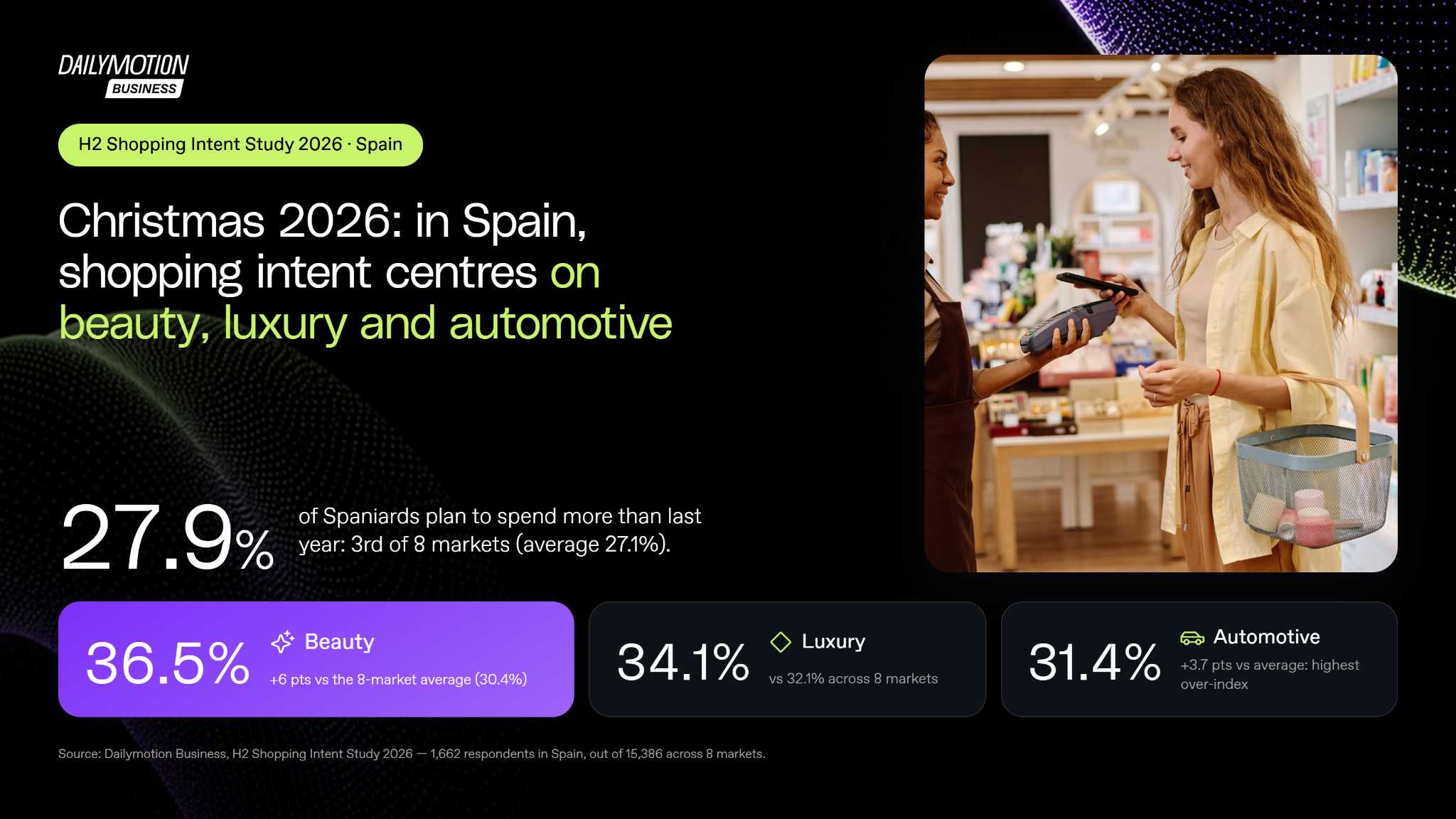
Spain actually ranks third out of eight markets in Dailymotion Business's H2 Shopping Intent Study 2026, with 27.9% of consumers planning to spend more, slightly above the eight-market average of 27.1%. Among 15,386 consumers surveyed across the U.S., UK, France, Italy, Spain, Brazil, Mexico and Colombia, Spain sits in a more resilient position than its surface-level caution suggests. The consumers who are leaning in are doing so with conviction, and they are concentrating their intent in categories that have real commercial scale: Beauty, Luxury and, perhaps most surprisingly, Automotive.
For marketers operating in Spain this season, the opportunity is not about waiting for consumer confidence to recover broadly. It is about finding the pockets where intent has already concentrated and reaching those consumers before everyone else starts bidding for the same purchase.
Beauty and Luxury Are Carrying Spain's Holiday Growth
When you break Spain's spending intent down by category, the picture sharpens quickly. Beauty leads with 36.5% of Spanish shoppers expecting to spend more, six points above the eight-market average of 30.4%, making it the strongest category in Spain and one of the most over-indexed Beauty markets in the study.
Luxury follows at 34.1%, also ahead of its global benchmark of 32.1%, while Automotive comes in at 31.4%, outpacing its average by 3.7 points.
What makes Beauty particularly compelling for marketers is not just the volume of consumers spending more, but the resilience of that intent. The net balance between those spending more and those spending less, a measure of how strong demand actually is after accounting for pullback, shows Beauty with a gap of just 6.1 percentage points, the smallest negative balance of any category in Spain. In a market where caution is real, Beauty is where Spanish consumers are most decisively holding their ground.
Luxury carries a wider negative net balance of 14.0 points, which is consistent with a category where a smaller number of consumers make a more deliberate choice to trade up. That asymmetry matters: Luxury in Spain is not a broad mass opportunity, but it is one where a meaningful share of shoppers are prepared to spend significantly more when the brand, the moment or the product earns it. The same dynamic plays out globally, where roughly 18% of Luxury shoppers say they will spend "a lot more," nearly twice the rate seen in Retail and Apparel.
For marketers in Beauty and Luxury, that means the growth is real but the audience is specific. Reaching the right consumers, at the right stage of their decision, matters considerably more than raw reach alone.
Spain's Automotive Surprise
The category finding that most deserves attention in Spain is Automotive. With 31.4% of Spanish shoppers expecting to spend more, 3.7 points above the eight-market average, Automotive over-indexes in Spain more than any other comparable market in the study.
That is not a trivial signal. Automotive is a considered, high-involvement purchase category, which means the consumers driving that intent are further along in a deliberate decision-making process. They are comparing, researching and building conviction, not browsing casually. For automotive brands and for the media that reaches those audiences, Spain represents a genuine window of demand that sits above what most global plans might assume.
It also reinforces the broader point about concentration. The Spanish consumer who looks cautious on an overall household budget level may be the same consumer actively planning a significant automotive purchase, and reaching that person through content and environments that match their research mindset will matter far more than simply being present across a broad seasonal media plan.
A Different Trust Map: What Spain's Ad Environment Tells You
If you plan Spanish media the same way you plan French or British media, you will miss something important. The advertising trust landscape in Spain tells a different story than most major European markets, and the difference has real implications for where brands should invest.
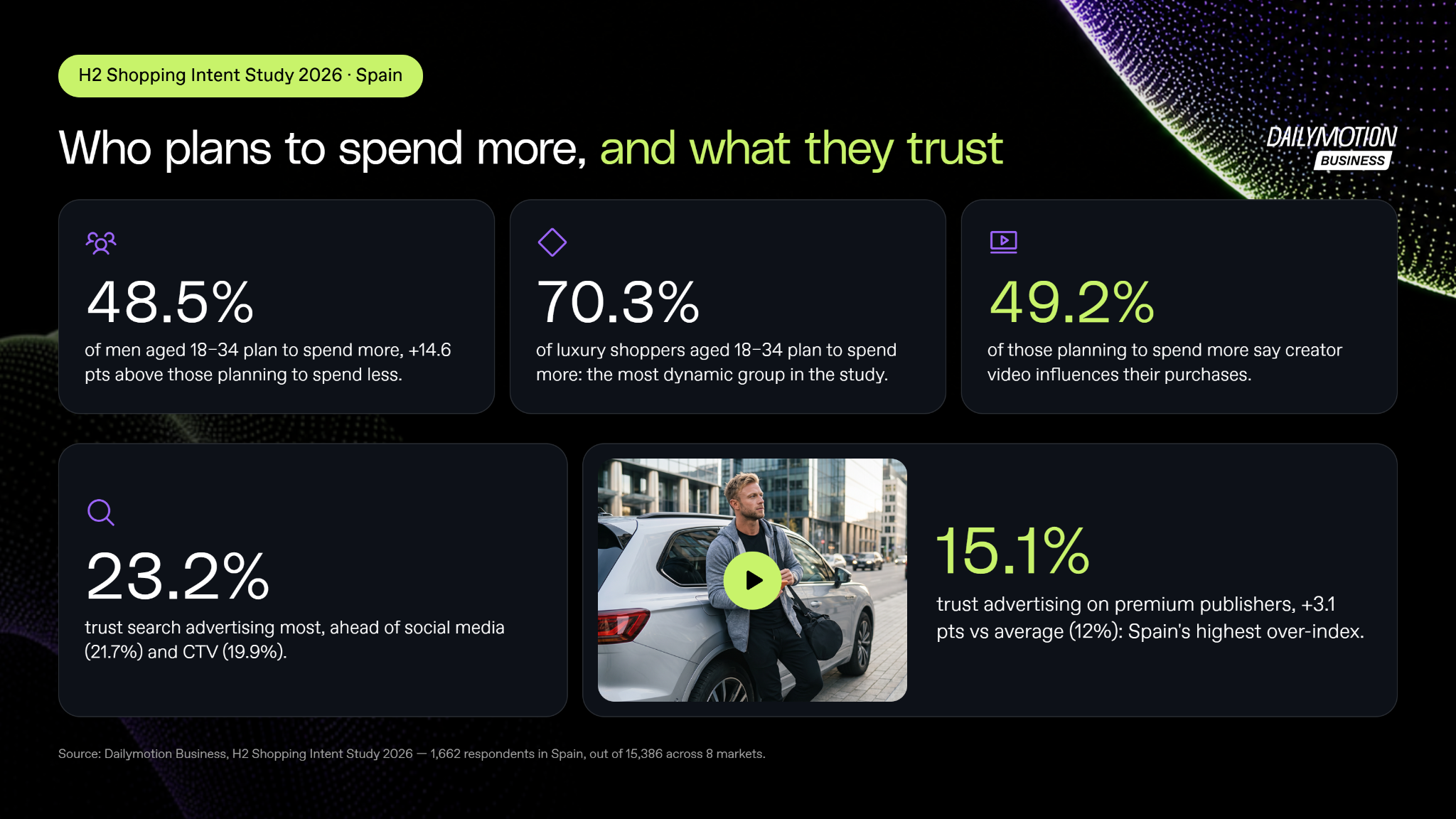
Search leads trust in Spain at 23.2%, slightly above the eight-market average of 22.2%. Social follows at 21.7%. CTV, which leads advertising trust in both France and the UK, ranks fourth in Spain at 19.9%, below its global average of 20.2%.
The most distinctive finding, however, is Premium Publishers. Spain scores 15.1% for premium publisher trust, 3.1 points above the eight-market average of 12.0%, representing the largest relative over-index of any advertising environment in the Spanish trust data. That is not a coincidence. It reflects an audience that is responsive to quality editorial context, brand-safe environments and content-adjacent advertising that feels considered rather than interruptive.
For marketers, that has two practical implications. First, premium publisher inventory in Spain is not a secondary consideration. It is a trust-advantaged environment that can do meaningful work across the funnel, particularly for categories like Beauty and Luxury where aspiration and context travel together. Second, the relatively lower CTV trust score compared with other markets suggests that a media plan built primarily around connected television, effective in France or the UK, needs to be reweighted for Spain, where Search and premium editorial carry more credibility with the consumer.
That does not mean CTV has no role in Spain. It means its role is different: less about being the primary trust-building environment and more about extending reach and frequency against audiences that have already encountered the brand through other touchpoints.
The Video Opportunity Among Spain's High-Intent Shoppers
Across the full eight-market study, more than 1 in 2 consumers expecting to spend more say video plays a concrete role in their purchase decisions, eight points higher than among all consumers. That finding applies with particular force in Beauty and Luxury, where creator-driven content influences 56% of high-intent shoppers compared with a 47% benchmark.
Spain's Beauty and Luxury shoppers are therefore not simply a category audience. They are a video and creator audience in an active discovery phase, using content, whether from creators, editorial sources or premium video, to identify products, read reviews and build the kind of confidence that converts into a purchase. The consumer planning to spend more on a Spanish fragrance, a luxury accessory or a beauty treatment is already encountering those categories through content before they ever enter a deliberate search.
That means the pre-purchase journey in Spain is longer and richer than a last-click or promotional model suggests. Reaching a Spanish Beauty shopper in October, through creator content or premium video environments that feel native to how they are already consuming information, is not simply brand building. It is audience development for a conversion that may happen weeks later.
From Black Friday to a Full Funnel: Rethinking the Spanish Holiday Calendar
The growing importance of October as a holiday activation window applies in Spain as much as anywhere else. As Prime Big Deal Days and early promotional moments increasingly function as entry points into holiday shopping rather than simply standalone events, Spanish consumers in categories like Beauty, Luxury and Automotive may begin their consideration journeys well before the traditional November window opens.
For marketers in Spain, that argues for a phased approach: use October to build awareness and establish relevance through creator content, premium publisher environments and search, where Spanish consumers already trust advertising the most. Then deepen that presence through the November promotional peak, using the signals generated earlier, engagement with beauty content, comparison behaviors in Automotive, editorial interactions in Luxury, to identify audiences that have already moved from passive to active intent.
The holiday plan that begins at Black Friday in Spain will find itself competing with brands that have been building consideration since September. The plan that starts earlier, in environments Spanish consumers trust, will be reaching audiences that already know the brand. That is a fundamentally different competitive position.
Finding Spain's Growth Pocket
Spain's holiday season is not the same story as the UK's, where CTV leads trust and consumer sentiment has reached its highest point in five years. It is not the same story as France, where Luxury and CTV work in combination. Spain has its own shape: a resilient Beauty market, a Luxury category that rewards deliberate positioning, an Automotive over-index that signals serious considered demand, and a trust landscape where premium editorial and Search outperform what most global media plans might allocate to them.
Nearly half of Spanish consumers are pulling back this season. But more than one in four are leaning in, and in Beauty, that share rises to more than one in three, the highest of any category in the market.
The brands that win in Spain this holiday season will not necessarily be those with the largest budgets. They will be the ones that understand where Spanish consumer intent has concentrated, which environments those consumers trust when they encounter advertising, and how to reach them during the discovery and consideration phase, before their intent becomes obvious and before every other brand starts competing for the same purchase.
Audience Path identifies the Spanish shoppers already showing those signals, across Beauty content, Luxury editorial and Automotive comparison behavior. Motion gives them a reason to choose you, through creator-driven content that travels from organic publishing into paid social, premium video and the publisher environments where Spanish consumers are most receptive.
The growth is there. It has just concentrated. And the opportunity is to find it before it finds someone else first.
Want to learn more? Access the full 2026 Shopping Signals Report here.
Source: Dailymotion Business, H2 Shopping Intent Study 2026. 1,662 respondents in Spain, out of 15,386 across eight markets. Weighted by gender × age. Results reflect annual spend intent compared with last year.
In this article